Friday, October 31, 2008

A word from Alby (Aka "Wombat")


“Hello World” Alby Mangels here (AKA Wombat, or Scott for those non the wiser). Steve and Terry (AKA Brett & Kelsey) has given up the ghost. Its 9.30pm and we have just arrived back from the Seisa Fishing Club where we enjoyed a fish burger and a few beers. We had some fantastic entertainment by the leading (probably only) band in the area.

Today has been a long day. Our day was via car, plane, bus, boat, ferry and on foot. After an early start this morning we finally reached Seisa at about 3.45pm. As soon as we arrived we high tailed out to Seafaris (Greg Bethune) where Brett has all his gear stored.

It certainly seems that Greg has been a huge part of this whole adventure for Brett, and would certainly a lot more difficult without him.

Greg has lent us a boat, a vehicle and shared some fantastic advice, to float everything to Crab Tomorrow. We have spent the afternoon and early evening getting the boat cleaned up and organised, which in the end was very satisfying. Having to start fresh tomorrow would have made a long day and probably put us back a day on getting to crab.

Tomorrow is where the real adventure begins. From the stories I have heard over the recent days, this blogspot is a G rated version. I encourage all of you to grill all individuals concerned to get the facts!!!!!

We have landed in the Torres Strait.


We arrived in the Torres Strait today after leaving Cairns early this morning. The views from the plane were spectacular as we flew over the Great Barrier Reef and the myriad of island and coral complexes. After landing on Horn Island we jumped on a boat to Thursday Island. We had a few hours on island where we enjoyed the cultural centre and learned about the fascinating Torres Strait Islander culture, before exploring the island on foot.

Wednesday, October 29, 2008

Alby Mangels / the Wombat has landed.

Yes, the Wombat has landed! We are excited to have my big bro Scott along for the ride and to spice up the adventure. Scott flew in this afternoon from Port Macquarie to Cairns. The big fella is pumped. This is his first time visiting Cape York/ Torres Strait and his first experience with sea turtles and crocodiles (which reminds me – I should mention to him that they bite!).

Kelsey & I flew from Brisbane yesterday and arrived in Cairns relieved to take in the fresh air after having to sit next to smelly, loud, obnoxious, non-deodorant wearing football players lacking social manners on their end of year trip to North Queensland. We are currently sitting in Cairns airport awaiting our flight to the Torres Strait. From there we will take a boat to Thursday Island, before boarding another boat to take us across to the mainland.

Flatback Backpacks


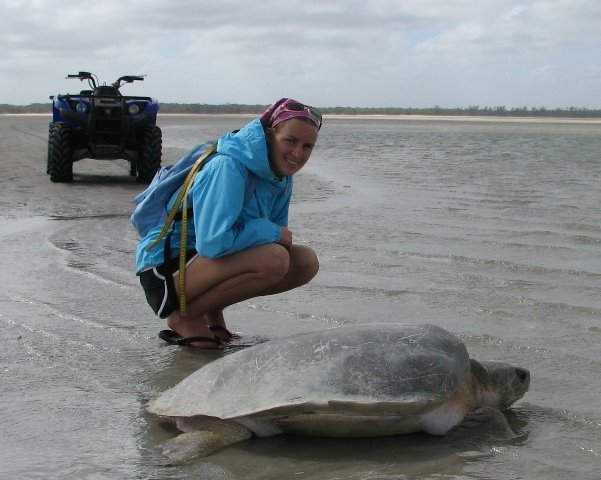
The normal technique for attaching satellite transmitters to sea turtles is by glueing them directly to the carapace. Not with flatbacks however. They have a soft skin which covers their carapace – when you scratch it, it actually bleeds. Attaching via this method is ineffective as the turtle sheds it’s skin and they detach quite easily. Therefore we have designed a harness or ‘backpack’ for attaching the transmitters. They are made out of nylon webbing and stainless steel. We have incorporated a ‘weak link’ which will eventually corrode and release the harness and transmitter from the turtle.

Tuesday, October 28, 2008

Programming the satellite trackers


It is a complex business tracking sea turtles. The satellite trackers have to be programmed to ensure efficiency in transmission and longer battery life – this means making them automatically turn on during periods when the turtle is most likely surfacing. I have also programmed them to turn on during the peak times in which Argos satellites are passing over Cape York. There are 5 satellites in total and each pass only lasts 10-15 minutes each day. I have programmed them to go into ‘standby’ mode at 4pm each day and turn off at 10pm. They are then turned on when the turtle surfaces to breath by a change in the conductivity and wet/ dry sensor. This then sends a quick signal to a satellite which is hopefully in range at the time.

Monday, October 27, 2008

Satellite trackers have arrived..


After much delay the satellite trackers have arrived from America (albeit with an added import tax as a nice surprise from the Australian government)! We now need to set these up with harnesses to attach to the flatbacks and program them ready for deployment.

Friday, October 3, 2008

The Cape York wilderness


We left the Northern Peninula Area a little lighter than when we arrived, leaving a lot of our gear (hidden) on the island and other gear in Seisia ready for our return in a couple of weeks. Our trip back down through the Cape York wilderness and along the old telegrath track took a few days. On the first night we camped at Eliot and Twin Falls and enjoyed the beautiful, clear spring fed water. After weeks taking salt water showers, the fresh water of the falls felt like paradise!


The next night we pulled up in Lakefield National Park, and camped by a billabong. No shortage of excitement here! Wild pigs in our camp, agile wallabies in and around us, dozens of fresh water crocodiles in the billabong and we discovered a new technique in catching barramundi - by tickling them! The night was filled with wild sounds of the bush - barking owls, barramundi 'boofing', scrub fowls, crocodiles, wallabies hopping through camp, small mammals scurrying and wild pigs! The morning was spent driving through the breathtaking landscape of Lakefield, with it's wetlands and billabongs, termite mound studded plains and array of bird life. We were excited to see birds such as brolgas, jabirus, radjah shellducks, jacanas, magpie geese and Australian bustards.


The next day we explored the Laura area and were mesmorized by the Quinkan Aboriginal rock art sites. The Quinkans contain some of the largest collections of rock art in the world. They represent ancestral spirits who lived in the cracks and crevices of the rocks - some were good and protected them, others were bad and crept around at night. It is an eery feeling walking into the area and knowing that 40,000 years before there were Aboriginals at this site painting their stories in the caves and on rock overhangs.


The landscape changed as we entered the Daintree rainforest and drove the rough, steep and rugged Bloomfield Track from Cooktown. The freshness and coolness of the rainforest was soothing after weeks of hot weather on Crab.

Thursday, October 2, 2008

"The Tip"


While around Seisia we decided to take a drive out to the most northerly point of the Australian mainland. On the way up we called in to The Croc Tent...the only souvenir and information shop on the way. It is run by a friendly couple who we spent time chatting with about our Flatback sea turtle research. Finally we reached a point where there was no more road. So we hopped out of the 4WD and walked the rest of the way to the tippety-top of Australia. We enjoyed the amazing views of Frangipani Beach and Torres Strait Islands to the west, and the Great Barrier Reef’s Islands to the east. We could even see Green sea turtles off shore…they are in this area right now to mate. As we stood together observing the beauty of it all we were greeted by a Green sea turtle who popped up right in front of us. Before departing we had a nice picnic on Frangipani Beach. Then on the way back to Seisia we stopped at a beach by Albany Channel. Here we wadded through the water and walked on lava formed rocks in order to reach a sandstone outcropping which formed a cave. Inside the cave was Aboriginal rock art which dates back thousands of years.


Monday, September 29, 2008

Back to Civilisation


We were picked up by the ‘Tropic Paradise’ on their way north back to Seisia and arrived back in civilisation late Sunday afternoon. We were exhausted but sad to leave Crab Island. It went so quick. On the boat we shared our stories with a group of New Zealanders and Americans who were eager to find out about our adventure. After only having each other to talk to for the past month, it was overwhelming conversing with so many new people. However, I savoured my first beer which an Aucklander gave me! After arriving back at the wharf we spent our time in Seisia cleaning gear and organising for our trip back south down Cape York. The noise of the ‘crowds’ in the camp ground overwhelmed us and we dreamed of being back on Crab. We can’t wait to return in another couple of weeks…

Sunday, September 28, 2008

On the beaches of Crab Island...

... a typical afternoon drive along the the beach of Crab Island and seeing some of the locals (there are 5 crocs in this pic - there were actually 9 before we took it which entered the water.)

Under Surveillance

We were filmed for suspicious behaviour the other day. Each week we see the Australian’s Customs plane fly over undertaking their patrols for illegal activity on along the remote coast line. Every now and then they will do a flight along the beach of Crab Island. On this particular occasion, the Customs helicopter was doing a patrol. Story goes - We had parked one of our ATVs on the northern end of the island in the middle of the beach. At the same time a small suspicious looking yacht was plying it’s way over the shallow waters just off the same northern beach – the first time we had seen a yacht so close. On the mainland a bushfire was burning frantically in the Jardine wetlands and the smoke was drifting over towards Crab Island. Kelsey and I were travelling north on the other ATV when the Customs helicopter came down very low and started doing circle’s around us. We politely waved. They then went out to the yacht and did the same and then to the other ATV we had parked on the beach. We were obviously being filmed. It was probably very bizarre for the Custom’s officials and they probably thought they had stumbled across a drug exchange or something – in their eyes, a suspicious yacht, a smoke screen from the mainland, 2 wild looking people on ATVs on a remote island! ….“Sir, we were only trying to count turtles! Honest!”….

Disturbing coincidence


On last year’s field trip we had been looking for clear evidence of crocodiles attacking adult sea turtles. It came in the form of finding a dead flatback on the sand flats of the north west corner of the island about an hour before we were to leave the island. This year we were looking for more evidence. In a bizarre coincidence, the first clear sign we found was of the dead turtle in the previous post - we found the turtle in exactly the same spot where we found the one last year and we found it about an hour before we left the island!

Crocodile Attack!!


(Warning: not for the light hearted.)

Last night on Crab Island a crocodile attack occurred. We discovered the aftermath this morning on the northern beach. The attack was brutal and a reminder of the power of a saltwater crocodile. The poor adult female flatback had most likely nested and was returning to the sea before being grabbed by a crocodile in the shallow water. The 200lb turtle’s shell was split in 2. Her carapace had huge crocodile puncture marks and had been crushed. All her limbs and her head were severed. It was upsetting to see but clear evidence of crocodiles predating on adult sea turtle. This is one of the only places in the world where crocodiles feed on sea turtles on a regular basis – or so we are discovering.

In fact this is not the first crocodile attack we have witnessed on this trip. We have found clear evidence of at least 6 other turtles being attacked. Three of these were identified by tracks and blood on the sand. Generally the adult females were returning to the water and at the same time crocodile tracks appear from the surf and intersect the turtle track. At this point there are scuffle marks and blood in the sand, and then no turtle marks (indicating the crocodile is carrying the turtle), drag marks or retreating turtle tracks (indicating an unsuccessful attack, though the crocodile may have attacked again in the water).

Another turtle we found had had her head crushed, and clear signs of crocodile teeth marks, but still nested ok. Another 2 we found with a piece of their shell dangling and fresh blood. A large percentage of turtles which nest show signs of older attacks, whether by sharks or crocodiles. Many girls are missing flippers, parts of their shells and have bite marks. Many still nest despite the fact that they don’t have 2 rear flippers to dig an egg chamber. Many still drag themselves out of the water even though they are missing a front flipper. They are tough girls and it is amazing the injuries they can survive.

*tracks and blood showing a crocodile attack on an adult sea turtle (crocdile track is in front of Kelsey)

Jabirus


This morning when we came around the northern corner of Crab Island after finishing our track count we startled 2 Jabirus. They are huge storks with dark iridescent necks, and white and black feathers on their body. Jabirus stand up to 115cm. They seemed very nervous upon our presence and flew off to the mud flats. We were able to watch these amazing birds through our binoculars. It was so neat to see them fly because they fly with their neck extended (rather than tucked in like a heron would). We have seen them fly over in the distance and their large tracks on the beach but this was the first close sighting of them.

Brett's life saving dive!


Last night Brett was walking up the dune when all of a sudden I saw him fly through the air. His leap was just in time to save a hatchling’s life. The innocent hatchling had been making his way down the beach to the water when a mean crab grabbed him and proceeded to drag him down its burrow. Lucky for the hatchling Brett was there to make the brave rescue.

This hasn’t been the only time we have seen crabs viciously grab hatchlings. There have been quite a few cases when unfortunately we weren’t able to help the hatchlings. With saying that there were a couple other times when Brett was able to pull the hatchling out of a crab burrow.

The ghosts which wander the oceans


One of the major forms of marine debris we find on the beaches of Crab island are fishing nets – very large nets designed to catch lots and lots of fish and other marine life. I have mentioned ‘ghost nets’ a few times in this blog but I thought that the subject really needed it’s own post. They haunt us each time we go onto the beaches here. They are called ghost nets for the reason that they are lost or set free and drift the ocean catching score of marine life as it goes. These nets can be mile and miles long. Eventually they will get washed up on the beach. Many nets will have carcasses of marine life, such as sea turtles, dolphins, crabs and fish. But the damage hasn’t stopped once they land on a beach. The next big storm will wash them back off the beach and send them drifting the oceans once again. For example, earlier this year a cyclone hit the west coast of Cape York here and sent hundreds of nets back into the ocean. A few weeks later many nets were washed back, along with hundreds of dead turtles.

There is not a part of the beach on Crab Island where you can stand and not be looking at a ghost net. Some are on the surface of the sand, others wrapped around logs and trees, whilst many are buried with only a small part of them sticking out. Most of these nets are from illegal fishing sources. Most nets can be identified to sourced by their design and the technique in tying the knots.

The scale of the problem is enormous and efforts are underway to start to mitigate the impacts. The local Aboriginal Rangers are doing a great job in removing and burning nets as part of the Gulf of Carpenteria Ghost Net Program. But the scale of the job is massive and more needs to be done. In the meantime, many thousands of sea turtles are still being caught in these nets.

Remote tropical island, turquoise waters, white sands… and surrounded by rubbish!


You would think that being so far away from any form of civilisation on a remote, untouched part of the Cape York wilderness that we would be free from any human influence. It’s far from the truth. The beach is littered with beach debris (ie. rubbish) originating from illegal fishing vessels, the commercial fishing industry, cargo shipping and from nearby countries such as Indonesia. Some of the things which land on the beach are just mind boggling – kids toys, refrigerators and thousands upon thousands of thongs (or ‘flip flops’). Some of the more common items are water bottles, glass bottles, gas cylinders, floats, rope and net. This is common on remote beaches all over Cape York and the northern Great Barrier Reef.

We have had to untangle a number of nesting flatbacks from ropes and nets which they have been caught in whilst making their way up or down the beach. One flatback had been caught in rope which was wrapped around her neck and strangling her. We also found hatchlings caught in a nest and unable to emerge because of rubbish which had been accidentally pushed into the nest by the nesting mother.

We undertook a beach debris survey on a 250m stretch of beach. A lot of products such as deodorant bottles, glass bottles, rope, net etc we can identify origin. We sourced 90% of the rubbish originating from Indonesian sources – illegal fishing vessels and possibly areas like Irian Jaya. The number of plastic water bottles is staggering, and is making us think twice about buying them anymore.

The amount of rubbish in our oceans is nothing short of a disgrace. To come to a remote location such as Crab Island and to see so much man made rubbish, and to see the effects first hand, makes you realise that the impact of humans is far reaching.

Marine debris in Australia is listed as one of the main threats to the recovery of sea turtle populations in the ‘Recovery Plan for Marine Turtles in Australia’ [www.deh.gov.au/coasts/publications/turtle-recovery/index.html]

52oC (126oF) and the girls are emerging!!


We had our hottest day on Crab Island yesterday – a sizzling 52oC (126oC)!! At about 12.30pm we looked out to sea, only to be surprised to see dozens of dark shapes swimming back and forth, parallel to the shore. Flatbacks were surveying the beaches, ready to nest, lifting their heads out of the water to look for a suitable nesting location. Shortly after they began to emerge and make their way up the beach to nest. They continued on all afternoon coming and going. By the end we had counted 461 turtles between lunch time and midnight.

No other species of sea turtle would even think of nesting in this kind of heat. In fact daytime nesting is quite a rare event in the world. Raine Island for example, which is on a similar latitude as Crab on the eastern side of Cape York on the Great Barrier Reef only about 150km away, sees many green turtles perish during the nesting period when they leave their run too late in the morning in returning to the water and simply ‘boil’ in the hot sun. So it is phenomenal to think that flatbacks can go through the whole nesting process, exerting huge amounts of energy, in that kind of heat.

Another day, another new snake...


Walking down the dunes from our camp to check on some turtles below Billy’s Bluff we came across yet another snake to add to the increasing list on Crab Island. This guy is a Slaty Grey who was about 6ft in length – another new record. We like to think that it is an island of friendly snakes, as we are yet to find a venomous one as yet…

Wednesday, September 24, 2008

Locals visiting Crab Island


This morning the waters were calm, making it easy for a few boats to cruise on down to Crab Island from the island and mainland communities. As we came around the corner up north, while doing our track count, we saw a boat land. We went around to say “hello” to three friendly Islanders from Seisia. They had come out to Crab Island to collect sea turtle eggs. They probe the sand with spears around freshly laid nests to find the eggs. They said they were going to harvest enough to fill a plastic trash can they brought along. In addition, on the boat ride they were searching for Green Sea Turtles in the waters to hunt (they taste the best, we have been told). Green turtles are currently congregating in the Torres Strait to mate, before heading to their nesting beaches to lay. We were informed that one adult turtle would feed about 4 families of 6 and during this time they catch around one each week.

Also, there were a few other boats on the adjacent mainland that came from Thursday Island and we are expecting them to come across to Crab later today. In the time we have been on the island we have seen and met a number of groups of Aboriginals and Islanders who have arrived in search of freshly laid turtle eggs, and the odd adult, along with some others offshore that hunt from the bows of their boats with spears and by jumping. I don’t think I would be able to jump off a boat into the water to catch a turtle knowing there are plenty of crocs and sharks about. All in all they have been friendly towards us and we hope to keep good relations with them.

The story of K96151 and K96152: sisters or best friends?


On Friday the 5th of September at 9pm we tagged 2 girls who were nesting side by side, just a little south of our camp. They were turtles K96151 and K96152 and were both nesting just below the slope of the dune. A couple of nights ago on Monday 22nd of September at 9pm we came across 2 turtles nesting next to each other. Both had tags. Kelsey read one and I read the other, both singing out in sequence “151” and “152”. Both girls had nested side by side again, exactly 17 days since we had tagged them originally nesting within a few metres of each other!! This time they had nested 130 metres to the south of their original location. Kelsey thinks they are either sisters or best friends and follow each other everywhere! It is either a big coincidence or there is something more to it…. Hmmm?

Then take last week. On one of the nights we were tagging turtles we noticed that a large majority of flatbacks on that particular night had white pigment across the backs of their flippers. Every other night we have had the odd one with white pigment, but this night most turtles had similar markings. Coincidence or is there something more to it….hmmmm?

Tuesday, September 23, 2008

Success in tag returns!


We are excited.
In previous posts during the first part of this trip you would have noted that we were frantically tagging turtles in a hope to get ‘tag returns’ when they came back to nest again after a couple of weeks. Flatbacks may nest 2 or 3 times in a season and the time in between nesting is known as the ‘renesting interval’. This is currently unknown on Crab Island – no one has ever identified the renesting interval for these particular turtles, which is important for identifying reproductive output. Last Thursday we were excited to pick up our first tag return – turtle number K96033, the 33rd turtle we had tagged back on about the 3rd day. Since then we have identified another 80 turtles which we had tagged previously on this trip!! Every night we go out now we are picking up more and more. On average, turtles are coming back to renest after 16 days.

We have also identified close to 30 turtles which have been tagged in previous seasons. This is important as it will help us identify ‘remigration intervals’ for the first time – another aspect currently unknown for Crab Island. We think that they will have a relatively short turn around of between 18 months to 2 years. Green turtles usually remigrate after 5 years and often as much as 7!

We are now focussed on identifying reproductive output by counting eggs and identifying hatching success of clutches. We are also prioritising getting Dna samples of turtles and collecting morphometric data of hatchlings.

Last week we finished up most of our tagging run and have tagged over 650 turtles!! This should provide us with a wealth of data into the future. We have very sore hands from writing and tagging! But we are not complaining…

The Lost Sea Turtles


So far while exploring inland on the island we have found 3 sea turtles skeletons. In addition, we saw tracks leading far into the island, behind our camp. These poor girls must have got disorientated while trying to nest or returning from nesting.

You know you have been in the wilds too long when…

…sitting at the dining room table enjoying lunch you hear something fall on the ground behind you. Kelsey, on the opposite side of the table and not prepared to rush the mouthful of food she is enjoying, casually states after a few moments “Brett, a snake just fell out the tree – it’s right behind you”.

“ahh… thanks?!” as I enjoyed the last of my sweet chilli chuna.

The snake which landed in our dining room was a northern tree snake – another new record for Crab Island. They are either very clumsy on Crab Island, or this particular guy likes to jump out of trees, as a snake ‘fell’ out of the same tree and nearly landed on Sam Prisk back on our May trip!

Wanted: Snow shovel

Our ‘drive way’ has become a popular nesting location. Without fail, each night as we arrive home we either drop into a new ‘body pit’ or become bogged in the soft sand which has been thrown by nesting flatbacks! We normally have to leave the quad bike where it gets bogged and then drag our tired bodies up the steep dune to get to bed! The next morning we have to clear the driveway of soft sand with our little shovel. We desperately need one of those big snow shovels sent from Connecticut or Ontario!!!

Monday, September 22, 2008

Turtle Magnets


When working on the beach in one place for more than a couple minutes turtles swarm from everywhere. It is like we are turtle magnets.
For example, last night we stopped at a female who was laying eggs. Brett stuck his hand in under her and collected the eggs to be weighed and measured. Once all the eggs were taken up and lined up to count, the mother began to hind flipper fill to cover where she laid. At this stage we needed to move her so we could safely return the eggs to the egg chamber she dug. It was a struggle (at least for me) to try and lift her; but together we were able to move the over 200 lb female away from her nest. Then the turtle attraction began…as we were counting the eggs she laid, hatchlings appeared. We looked around to find them emerging under the mother who we had just moved. I jumped up to save them from being crushed by the female’s large determined flippers. I saved them and tried to continue with our collection of data. Brett cleaned off and measured the maximum and minimum width of the eggs while I weighed them. Which sounds easy but when I was trying to weigh an egg on the scale (which is annoyingly wind sensitive), the 50-60 hatchlings wanted to climb all over the scale too. Then the mother decided that instead of returning to the water she wanted to come towards where we were working. First she tried to run over her nest which was uncovered since we were taking measurements of her eggs…Brett saved them by throwing sand over just in time and turning her towards the water. Phew, she was heading to the water and we could get back to work. Then, again, she came crawling towards us…what the heck! We tried to turn off our lights thinking that was distracting her, since the moon was not out yet to lead her back to the shiny water. This did not work and she was determined. After running over our gear Brett was able to move her and she seemed to be headed the other way. So back to work we went…then all of a sudden she was nudging into my back. Come on, we are trying to work here Mrs. Turtle, can’t you see that? In addition to her, two other adult females were headed in our direction…thankfully they turned before coming too close. We finally finished weighing and measuring the eggs somehow and returned them to the nest and completely covered them to insure their safety. Next we had to weigh and measure the hatchlings. It was far too frustrating having turtles everywhere while trying to collect the data. We couldn’t stop them from being attracted to us. It was like they wanted us to tag, weigh, and/or measure them. So we picked up 10 hatchlings put them in my bag and moved down the beach. In order to hide from those turtles who were drawn to us, we turned our spot lights off for a few minutes. When we thought we had lost them we turned on our lights and finished the measurements of the hatchlings. I love having so many turtles around but it was a challenge to do research when we were like magnets pulling in all that were in that area.

A moment to savour


There are many times on Crab Island in between the hard work and heat when you stop, take a deep breath and soak up the place and moment. A couple of nights ago was one of those moments. It was a full moon, the beach was bright and had the bluish hue that only a moon, unaffected by artificial lights, can shine. It was still, with only the sounds of gently breaking waves and the odd shore bird, and we were on the beach towards the south of the island. The beach stretched on into the far distance, before disappearing into the ocean as the island bent towards the east, the water reflecting the glow of the moon. Standing there and looking south we could see small ‘explosions’ of sand, rising to a couple of metres, scattered all over the beach and as far as we could see. Within the ‘craters’ of these explosions were glowing dome shapes, the shells of sea turtles reflecting the moonlight. Within the waters, beyond the surf break, within the surf and on the waters edge, sea turtle’s shells glowed, still wet, as they emerged to nest. Turtles could be seen making their way up the beaches, stretching into the distance, their backs still wet from the ocean and reflecting the blue moon brightly. The sounds of sand being flung like a beating rhythm and the deep breaths of turtles as they struggled to drag their heavy bodies up the beach now dominated. It was a moment to savour, one of many….

Hey Daz, we found Baz!


Baz, the cane toad has been sighted in and around our camp multiple times. For those who have never heard of cane toads, they are an introduced species to Australia. They are poisonous and are killing off many native animals, making them an unwanted pest. It is a shock having them on the island…they seem to be invading everywhere here in the north. We aren’t sure how they got to the island but maybe they drifted on a log or a bird carried their eggs from the mainland. Here on the island they are a threat to the snakes and birds which eat them.


The things you find on the beach.


We find many interesting thing on the beach. Last night whilst out on the beaches we were surprised to come across a water python slowly wandering through the nests of turtles. We know 1 was recorded on Crab Island 17 years ago, but this is the first since then.

Flatback sea turtles: endangered or not?


It would be easy to wonder how the flatback sea turtle is a threatened species seeing we have counted over 4500 turtles since our arrival. However, while it would be great to say the species is stable, the reality is there are a number of factors which make them vulnerable to extinction. The numbers we are seeing are probably only a proportion of what was a much wider and larger nesting population. Crab Island is possibly a remnant of what was once a population which nested right down the west coast of Cape York.

The fact is Crab Island supports the majority of nesting females for the entire species and seeing so many comes as no surprise. We are at the peak of the nesting season, seeing the majority of females. To put things into perspective, when you compare Crab Island to other major Flatback rookeries, such as those in central Queensland, the Northern Territory and Western Australia, it is clear that Crab is the hotspot. These other rookeries support several hundred nesting flatbacks each year, with a combined total of several thousand. Crab on the other hand can support several hundred each night, and may have a nesting population of between 10,000-15,000 females.

What’s the fuss you may say? Well, while we know very little about flatback sea turtles, we do know they have suffered severely from various impacts in recent decades. For starters, the three decades from the mid 70’s saw intensive trawling effort in northern Australia and the Gulf of Carpentaria. This tripled in intensity by the mid 90’s before being regulated. During this period tens of thousands of sea turtles were trawled up each year and the majority of these were flatback sea turtles. The impact of this was not immediate, and we still probably haven’t seen the result of these activities. The reason being was that most of the turtles trawled were sub-adult turtles. This is important as sea turtles are a long lived species (they may live over 100 years, but no one has studied them long enough to know), and they may not mature until they are 35–50 years old. Therefore, a generation of turtles may have been severely depleted and we will not see that impact until at least next decade.

On top of this, feral pigs are destroying close to 100% of nests on the mainland. This means that no eggs are hatching and no turtles are being recruited back to the population. It is likely that turtles which lay on Crab, also lay on the adjacent mainland and make up one large breeding unit. No eggs hatching is bad enough. What makes this worse is that the evidence we have collected to date suggests that mostly females are born on the mainland and mostly males on Crab Island (sex of hatchlings is determined by sand temperature). Females are the most important aspect of the survival of any species – no females being recruited to the population is not a good thing.

Once again, the impact of feral pig predation on nests will not be seen for a couple of decades. All of a sudden there are several generations of turtles which will not be breeding. They will struggle, but they have survived since before the dinosaurs, through ice ages, etc, so they are a pretty tough species. They may survive and continue on, unless they were pushed to the edge by something major…

Climate Change - A threat in itself to the existence of sea turtles, and could certainly be the nail in the coffin when you look at the cumulative impacts on flatbacks. Sea turtles will be one of the first species impacted by climate change – they are very dependent on a stable temperature. For example, the sex of hatchlings is determined by the temperature of the nest during incubation. There is a pivotal temperature during incubation (around 27oC/80oF) – hotter than this it will produce females, colder and you get a male. But there is a small window which results in mortality – sand temperatures above 32oC/90oF or below 24oC/75oF will result in mortality. The reason that Crab Island supports so many nesting turtles is that the sand provides the right and stable temperature range for incubation. It’s not as simple as moving to a new nesting beach.

For a small island such as Crab, where a lot of turtles lay their eggs just above the high tide mark, sea level rise could also result in flooding of nests and high mortalities. It is unknown what higher sea temperatures will do to food resources and traditional feeding grounds.

Other factors which require investigating are some reports of flatbacks turning up in markets in Irian Jaya (Indonesia). Crab Island’s close proximity to the indigenous communities of Bamaga and Thursday Island also means that the traditional harvest of turtles and eggs remains unmonitored. The island is much more accessible these days with the use of outboard motors, rather than the traditional dug out canoes.

In addition, while the trawling activities in Australia’s northern waters have now been regulated with the introduction of mandatory ‘Turtle Exclusion Devices’ (TEDs), there is increasing illegal fishing in these waters. Having overfished their own waters, and with the rich abundance of fish stocks in Australian waters, it is tempting for illegal Indonesian fishing boats to plow the same waters in which flatbacks occur. Indeed, thousands of illegal fishing vessels enter these waters each year, overwhelming the customs vessels which patrol them. The catch of flatbacks remains unmonitored but is most likely high.

The other factor associated with illegal foreign fishing vessels is their habit of discarding or losing large fishing nets, sometimes miles long. These are known as ‘ghost nets’ and their impact should not be underestimated. Indeed on Crab Island there is a washed up ghost net at least every 100ft –and those are the ones you can see which have not been buried. These nets drift the oceans catching countless numbers of sea turtles and other marine life before being washed ashore. But the reason they are known as ghost nets is that when a storm hits they are normally washed back off the beaches and back into the oceans to catch more marine life.

The cumulative impact of these threats may be sudden and irreversible. Add to this other factors such as increased boat strike, increased tourism, pollution (we have identified for the first time fibropapilloma on flatbacks – a tumorous growth associated with poor water quality) and the fact that Crab Island remains unprotected. Simply, this means the flatback sea turtle is far from being safe and secure.

These are some of the main reasons why the flatback is listed as a threatened species. But all is not gloomy and we, personally, remain optimistic – the flatback’s range is mostly contained within Australian waters, unlike most other sea turtle species who are found globally and whose range may cross many international borders. This presents an opportunity for effective protection. Crab Island is still a remote location and this in itself provides a level of protection. However, Crab Island is too important a resource to not have any formal protective status over it. It is still open to interests such as mining or major tourism. The opportunity exists to secure the island for prosperity and to start to mitigate the major threats highlighted above throughout their range. But this has to start immediately, conservation strategies are long overdue.

The purpose of this study is to start to get a good understanding of the population dynamics of the breeding cohort of Crab Island’s flatbacks – are they decreasing, stable or increasing? At the moment it is unknown. Only a long term monitoring study will determine this, and conservation strategies can be better informed which will assist in halting any downward trends.

Thursday, September 18, 2008

Meet our new neighbours


In the last week we have had some new neighbours move in and start building next door. They are a pair of sunbirds which have been frantically building a nest next to our tent. They both are a beautiful bright yellow and the male has the most amazing iridescent blue on his throat. They are a bird of tropical northern Australia, and to see sunbirds again is a great reminder of where we are.

The nest is a hanging, pendant style made of feathers, leaves, twigs, cobwebs, and bark. They must have the best view on the island having built their nest right on the headland overlooking the water! It has been great watching them busily build. They are near completion and ready for some spring lovin'!!